History of Rileys Island
Rileys Island, once known as Shell Island, is a mangrove surrounded island near Empire Bay and the second largest in Brisbane Waters. It lies at the northern tip of St Huberts Island, separated from Davistown and the Veterans Hall wharf by the Lintern Channel. Today it is a protected nature reserve managed by NSW National Parks & Wildlife, maintaining its natural and historical essence. The island has a rich history, evolving from shell harvesting for producing “quicklime”, to cattle farming, banana plantations, and shipbuilding. In recent history it was at risk of being destroyed for housing development but was saved by environmental advocates with support from the Builders Labourers Federation and comedian Spike Milligan, through a series of green bans.
The island's history is rooted in the story of John Riley, a former convict transported to Australia on the Phoenix in 1828 for highway robbery. Family oral history has it that John was a short chap (4’ 11 ½”) but tough. By the mid-1830s, Riley and his wife Elizabeth settled in the Brisbane Water area, farming around Cockle Creek and Shell Island. Son William born 1841. Elizabeth died tragically in 1842, but John Riley continued farming, later marrying Margaret Costigan (1843), with whom he had three more children: James, Thomas, and Ellen (also known as Sarah).
In 1855, Riley acquired Shell Island from the Crown for £140, transforming it into his personal domain. Their home was built on the eastern side of the island, facing Cockle Creek (Empire Bay), with the kitchen initially housed separately in a shed that eventually burned down. The main house (3 bedroom) survived, with one of its bedrooms later converted into a kitchen. The 112-acre island featured diverse landscapes, including mangrove swamps, swamp oaks, and bloodwood trees, and was nourished by a natural spring. Its strategic position along Cockle Creek's deep waters made it ideal for living and shipbuilding, a central part of the Riley family's business.
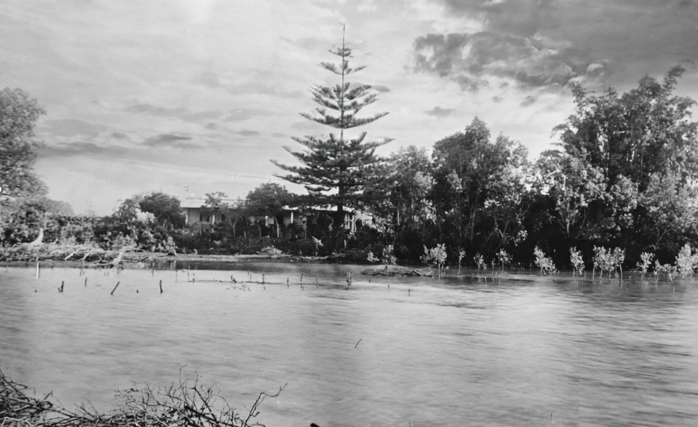
The original home built by John Riley, eastern side of Rileys Island facing Cockle Creek.
John Riley's sons embraced seafaring, with William becoming a sea captain and Thomas, a shipwright. Vessels built on the island were “Maggie Riley", “Bellbird” and possibly the ketch “Brothers”. James, despite being deaf and mute, also became a skilled boatbuilder. Ellen married Giles Jenkins, a shipwright from Davistown, further cementing the family's nautical legacy. The island's agriculture flourished, with John Riley establishing a banana plantation fertilized with seaweed, possibly inspired by neighbouring plantations.
Thomas Riley and his wife Susannah faced personal tragedies, including the drowning of their six-year-old son John (Jack) in 1896 near Rileys Island and the death of their eldest son Walter, a promising sculler and swimmer, off Cape Three Points in 1905. Walter’s body was recovered and buried in the orphanage cemetery at Kincumber South.
The Maitland Mercury noted Rileys Island’s significance in 1887, highlighting its banana plantation as the largest in the area. The island’s accessibility was improved with the creation of Lintern Channel (1921 -1922), which provided a navigable route from Veteran Hall to Cockle Creek.
John Riley died in 1885, leaving Margaret and their sons Thomas and James on the island. From John Riley’s four children, 39 grandchildren were produced, with many descendants still residing in the Central Coast area. John Riley’s descendants expanded into other ventures, including the Rileys Bus service, movie theatres in Woy Woy, Ettalong, and Umina, and taxi services.
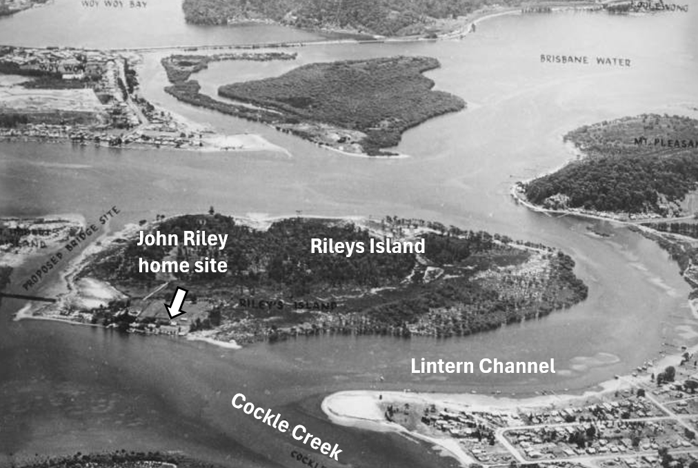
Rileys Island, Brisbane Waters
The island remained with the Riley family until 1946 when it was sold to the Daisley family (weekender). In 1960 they sold it to St Huberts Island Pty Ltd, intending to develop residential housing on St Huberts and Rileys islands. In the 1960s, Hooker Rex Corporation proposed a canal-style housing development on Rileys Island, like St Huberts Island. Some land clearing and test dredging was conducted, with remnants of this activity still visible on the island today (large trenches and several large, rusted buoyancy tanks from the dredge). In 1961, Gosford Council rejected Hooker Rex's application to develop Rileys Island, but the company successfully appealed to the Minister of Local Government in 1964.
Despite this approval, a strong community campaign, led by university students and residents who formed the Central Coast Environmental Protection Council, emerged to oppose the development. Petitions circulated, public meetings were held, and publicity efforts garnered support, including from Spike Milligan. The Save Rileys Island Committee, formed in 1975, expanded the campaign to involve the Trades and Labour Council, which placed a green ban on development work. It worked.
In 1980, the Crown purchased Rileys Island from Hooker Rex, and by 1989 it was designated as Rileys Island Nature Reserve. Today, it serves as a testament to the resilience and ingenuity of its early settlers. Managed by NSW National Parks and Wildlife, it plays a crucial role in preserving endangered ecological communities, seagrass beds, intertidal mudflats, and habitats for migratory birds. Rileys Island is a cherished site where visitors can reflect on its varied history.
By Robert Thompson
References:
Good Old Woy Woy, by Charles Swancott,
The Shipbuilders of Brisbane Waters, by Gwen Dundon
The Maitland Mercury and Hunter River General Advertiser Oct 1887
The Gosford Times and Wyong District Advocate June 1922
Newcastle Morning Herald May 1905.
Gosford Public Library
Interviews with members of the Riley family: Quentin, Virginia, Winston, Noel and Victor.